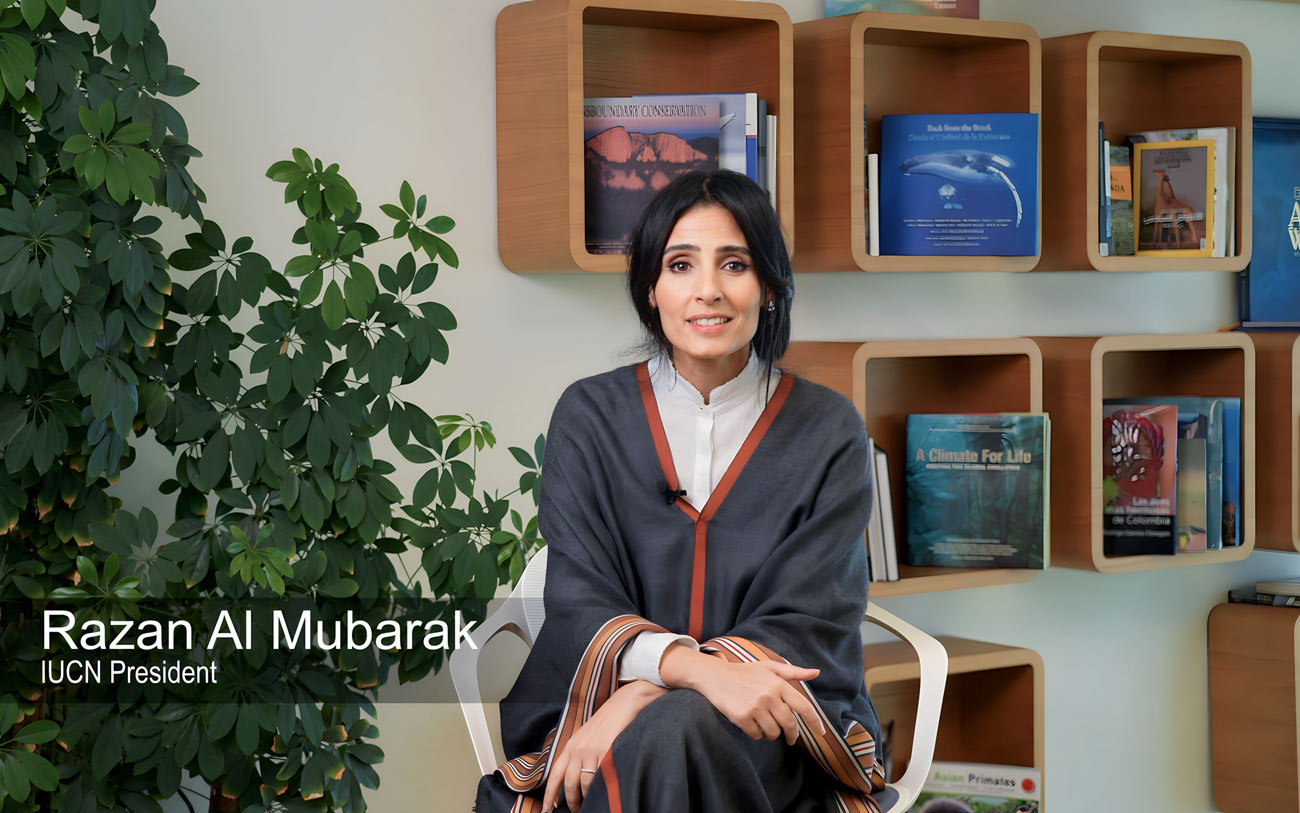
Razan Al Mubarak Re-elected President of the International Union for Conservation of Nature

Razan Khalifa Al Mubarak, President of the International Union for Conservation of Nature (IUCN), has been re-elected for a second term at the IUCN World Conservation Congress in Abu Dhabi, United Arab Emirates.

Ms. Al Mubarak is the first president from West Asia and the second woman to lead IUCN in its 77-year history.

Ms. Al Mubarak’s re-election was announced today at the IUCN Members’ Assembly, following a four-year term marked by strengthened governance, renewed trust, and the elevation of nature within global climate and biodiversity agendas. A majority of IUCN’s more than 1,400 Member organisations, representing 160 countries, confirmed their confidence in Ms. Al Mubarak to continue leading the Union through this decisive decade for nature.

Ms. Al Mubarak said of her re-election as President of IUCN:

“I am truly honoured to have been re-elected President of the IUCN, especially at a moment when nature, climate, and people must be brought together in action. Over the past four years, I have witnessed the extraordinary strength of our Union — our Members, Commissions, and partners — working together across boundaries and disciplines. I remain profoundly grateful for the support of the UAE leadership and its institutions, whose belief in conservation has inspired my own. This new mandate is both a privilege and a responsibility — to continue turning ambition into action for nature and for humanity.”

The world's oldest and largest global environmental network, IUCN is a democratic membership union that harnesses the world’s most influential organisations and experts to conserve nature and accelerate a global transition to sustainable use of natural resources. Composed of more than 19,000 conservation experts and 1,400 Member organisations, including States, government agencies, subnational goverments, NGOs, and Indigenous Peoples’ organisations, IUCN is considered the global authority on conservation. 

Her re-election comes as IUCN launches a new four-year Programme of Work — the final one before the global biodiversity, climate, and land restoration targets are due in 2030. Under Ms. Al Mubarak’s leadership, the Union will work to deliver on its 20-year Vision, turning ambition into measurable outcomes and ensuring that IUCN continues to guide collective action for nature, climate, and people worldwide.

His Excellency Mohamed Al Bowardi, Deputy Chairman of the MBZ Fund and UAE Minister of State, stated the following:

“Thanks to her passionate, innovative, and decisive leadership, the Mohamed bin Zayed Species Conservation Fund has become a global model, showing that small but focused interventions on the ground can make a big difference in saving species. We know that she will continue to bring this same sense of commitment, creativity, and collaboration to IUCN as it sets the global agenda for this crucial decade for conservation.”

Ms. Al Mubarak began her career in conservation in 2001 when she helped to establish Emirates Nature – WWF, an NGO associated with the World Wide Fund for Nature. At Emirates Nature – WWF, she spearheaded initiatives to protect the UAE’s coral, conducted research leading to the establishment of the country’s first mountain national park, and created the framework to protect nesting and migrating sea turtles.

In 2010, Ms. Al Mubarak became the youngest person to lead an Abu Dhabi government entity with her appointment as Secretary-General of the Environment Agency – Abu Dhabi (EAD), an organisation for which she now serves as Managing Director. In her role leading a government agency of over 1,000 employees, EAD was instrumental in the successful reintroductions of the Arabian Oryx in the UAE and the Scimitar-horned Oryx in Chad.

Ms. Al Mubarak has helped build the Mohamed bin Zayed Species Conservation Fund (MBZ Fund) into one of the world's largest philanthropic endowments supporting direct species conservation. Since its inception in 2009, the Fund has supported more than 3,100 projects worldwide, contributing to the rediscovery, reintroduction, and protection of over 1,900 species. Under her leadership, it has evolved from a small grants programme into a platform advancing broader conservation initiatives that link biodiversity, sustainability, and human well-being.

In addition to her national roles, Ms. Al Mubarak serves as UAE Sherpa to the High-Level Panel for a Sustainable Ocean Economy, Co-Chair of the Taskforce on Nature-related Financial Disclosures (TNFD), and Nature Champion at the World Economic Forum. She also previously served as UN Climate Change High-Level Champion for COP28 UAE, where she played a key role in elevating nature’s role in global climate action.

Ms. Al Mubarak holds an MSc in Public Understanding of Environmental Change from University College London (UCL) and a BA (Hons) in Environmental Studies and International Relations from Tufts University, USA. She also serves on the boards of Panthera, Re:wild, and the Tropical Forests Forever Facility.

Video: Razan Al Mubarak Talks About Seeking a Second Term as IUCN President

Razan Khalifa Al Mubarak, President of the International Union for Conservation of Nature (IUCN), has been selected as a candidate for a second term. She stated:

“Serving as President of IUCN—the world’s oldest and largest environmental network—has been one of the greatest honours of my life.

Today, I am deeply humbled to have been selected by the IUCN Council and Election Committee as a candidate for a second term. I would be honoured to continue this journey with you.

Over the past four years, with the support of our Council, the leadership of our Director General and Secretariat team, and the dedication of our Members, we have strengthened our Union: advancing a 20-Year Strategic Vision for IUCN, improving governance, and elevating the voice of nature on the global stage.

IUCN was founded to conserve nature and promote the sustainable use of natural resources. Today, the world increasingly recognizes that safeguarding nature is essential—not only for biodiversity itself, but also for human wellbeing, resilience, and the future of our planet.

As we prepare to gather this October at the IUCN World Conservation Congress in Abu Dhabi, we have an important opportunity to shape an even more ambitious path forward.

That is why I am seeking a second term: to help IUCN, together with its Council, Director General, Secretariat, and most importantly, its Members, deepen its impact, strengthen its partnerships, and continue to be the leading global voice for nature at this critical time.

The strength of IUCN lies in its diverse and influential membership, who are uniquely positioned—both globally and locally—to deliver meaningful action for nature and biodiversity where it matters most.

With your support, I am ready to continue this vital work—together—for nature, and for the future we all share.

Thank you.”

Razan Al Mubarak Marks Her Second Anniversary as IUCN President

Razan Al Mubarak shared a message to mark her second anniversary as President of the International Union for Conservation of Nature (IUCN). In her speech, she highlighted the importance of inclusion to solve the current climate crisis.

“One of the cornerstones of our work for the last two years has been a focus on inclusion. And by inclusion, I don't mean an aspirational touting of petty talking points. I mean real inclusion specifically of women, Indigenous people and youth at the decision-making nexus on the critical issues of both biodiversity loss and climate change.”

Ms. Al Mubarak, who was named the UN Climate Change High Level Champion for COP28, also spoke on the importance of nature-based solutions to tackle the current climate crisis:

“To that end, another key principle that I have focused on as we lead up to COP 28 is that very intersection and inevitably the importance of nature based solutions. We at IUCN have spent many years championing the importance of nature based solutions, and I am happy to report that we are making great progress in promoting this very concept on the global stage for the first time at COP28, countries will follow the Paris Agreements mandate to take stock of our collective progress towards achieving the agreement's key goals.

Unfortunately, it is now clear that we are not meeting critical targets. Getting back on track and addressing these gaps will require changes not just in energy and transportation, but also in how we farm, how we build, how we manufacture, and how we invest in conserving and restoring nature. Most nature based solutions are faster and more cost effective than any engineered solutions out there, many of which are still decades away from removing carbon on a scale that's even close to what nature can do.”

Watch Ms. Al Mubarak’s full speech on YouTube.